Find a franchise that can meet all your requirements. The name appears professional. The business model seems rational. You’re interested in the field. Imagine yourself as the person who runs the operation.
There are three locations within the same franchise in the area you are targeting. Furthermore, there are several painting franchises in town, and a franchisee that has more territory.
This doesn’t mean that the opportunity bad.
This doesn’t mean you don’t need a map to make a sale.
The second half is to comprehend what market it is in which the business will actually be operating. Knowing the local market is equally important.
A national brand can become an local business
Franchises can be marketed as the brand. The prospective buyer is informed about the idea, potential and the support system.
Customers don’t feel the same way about the business nationwide. They work with a local employee.
That makes territory research especially pertinent for home-based services such as painting. For instance, anyone interested in franchises for painting AL should be aware of the existing brands operating within the Alabama metropolis.
The same concept applies to franchises for painting NC prospects. The global footprint of a company tells you which area it’s in. The national footprint of a company does not provide information about the way it is represented in the North Carolina market you are interested in.
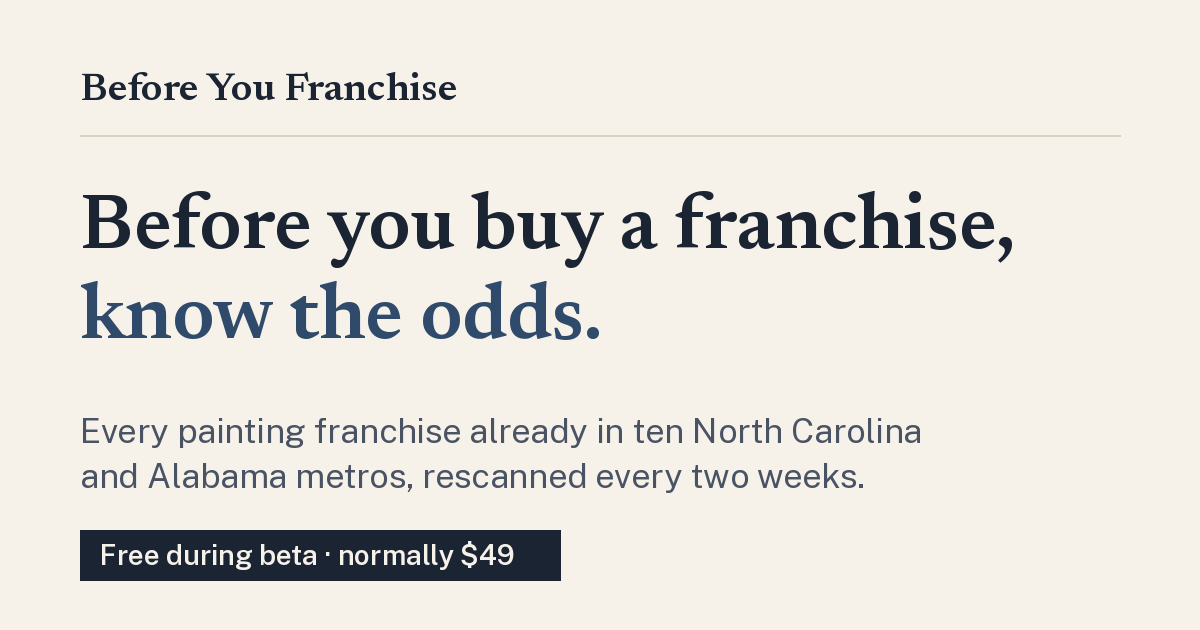
Before You Franchise tackles the issue by monitoring franchise activity across five metro areas in North Carolina and in five others in Alabama.
Take a look at where the brand is growing
It’s not just the ringing of “growing franchise” that makes it appealing. It’s also possible to determine exactly where growth is happening.
A list of places gives a quick overview. After several observations you will begin to track movements.
Based on the information provided, Before You Franchise checks the lists of locations for painting franchise brand brands every two week. This adds a new aspect to the research on painting franchises. Prospective buyers can check out those who are already in the market, and then see how the footprints of brands have changed instead of using a single impression.
Imagine two franchises that appear identical on the surface.
A company is steadily adding new locations within the metropolitan areas you’re thinking about. One company has a big reach across all markets, but not enough movement in certain areas.
It doesn’t say what franchise to buy. You should ask more questions.
Why would one want to expand there? Are territories still available? Who owns the franchise? What does the franchise disclosure material show? What are the opinions of current and former franchisees?
Research should help reduce uncertainty however, it shouldn’t create certainty.
The Ownership Map provides context
Two franchise owners don’t need to be independent.
A single operator could have multiple regions or sites. The knowledge of who’s in charge of existing operations adds context to a simple count.
Multi-unit ownership for instance can prompt a prospective buyer to investigate the reasons behind why a franchisee has was able to expand. This could raise questions regarding the remaining territory or the local competition landscape.
The information on ownership alone should not be used to make any decisions.
That’s an important part of learning how to research a franchise before investing: treat each piece of information as the beginning of another question rather than proof that an opportunity is good or bad.
It’s not the same as an empty Market
A franchisor might have a territory accessible in a metropolis where painting brands from other companies are operating.
Those are two different facts.
The issue with the territory is the franchise system you are contemplating. The question of market is more general. What other franchises offer similar services in the vicinity? Which franchise brands compete against one another? How long have they been established? Is the field becoming more crowded?
Before You Franchise, a product developed by an ex-franchise agent, makes use of AI agents to analyse data about the locations of franchises in its markets. Its focus on locations for brands along with growth and ownership may help buyers conduct additional research before they make a major financial commitment.
Franchise due diligence doesn’t have to stop there.
It’s a good place to start when trying to make better inquiries.
A franchise can boast an impressive name, an appealing presentation, and a area that is marked “available.”
Compare more than just franchise costs and brand awareness before you commit to investing capital. Look at existing locations, owners patterns, local competition, available territory, and the recent expansion. Before making a major investment, you must conduct thorough research into the market for franchises. This will enable you to get a better understanding of the market for franchises and will allow the franchisor to answer the appropriate questions.